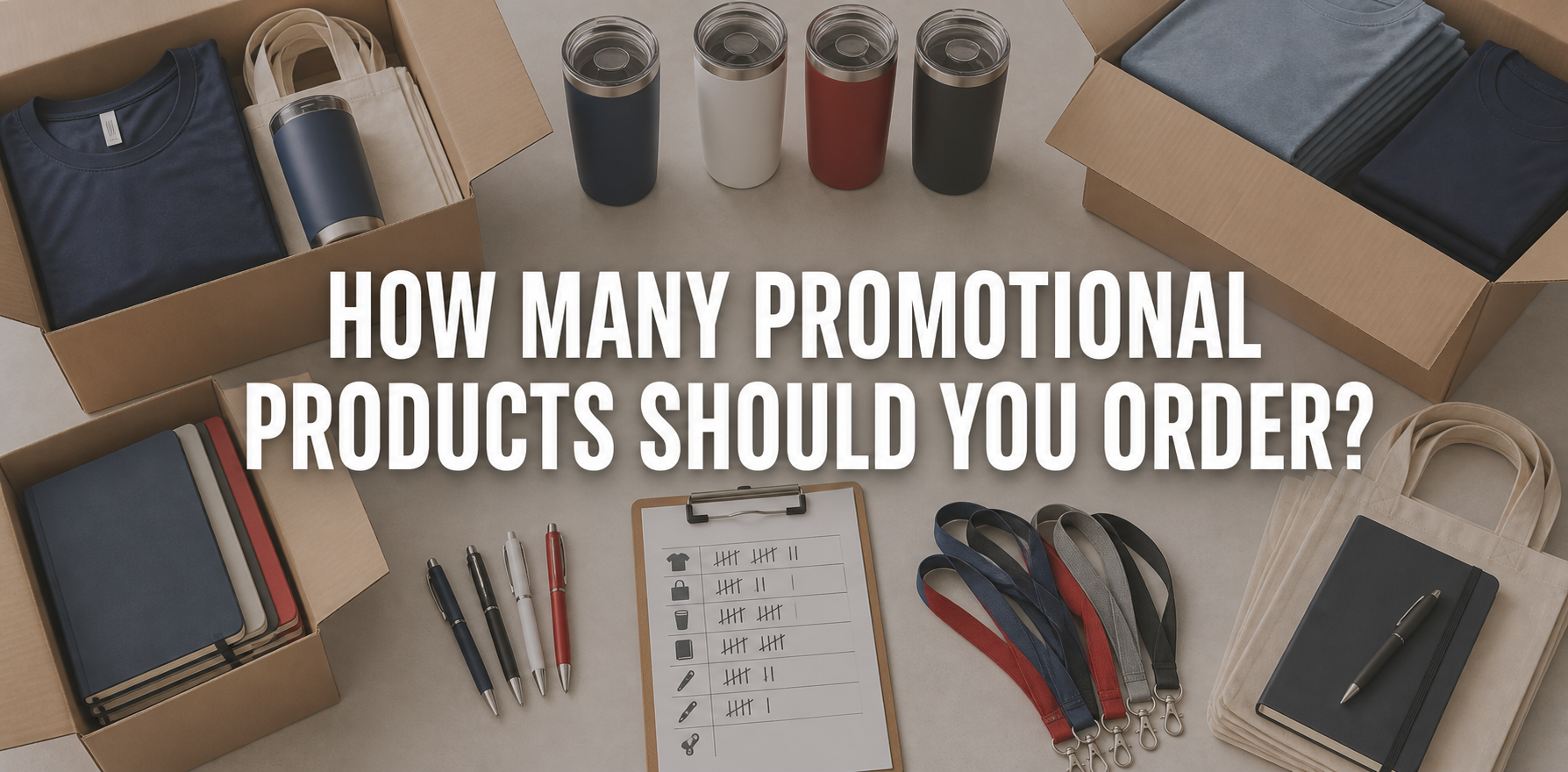
How Many Promotional Products Should You Order? A Practical Guide to Avoiding Shortages and Leftover Swag
Ordering promotional products often starts with a deceptively simple question:
How many should we get?
Order too few, and you may run out before everyone receives one. Order too many, and you could end up with boxes of leftover merchandise taking up space in a storage closet.
The right quantity depends on more than the number of people attending your event or working at your organization. Your goals, audience, distribution plan, budget, timeline, and ability to reorder all play a role.
Here’s how to choose a quantity that meets your needs without creating unnecessary waste.
Start With Your Distribution Plan
Before choosing a number, decide exactly how the promotional products will be distributed.
Are you handing them to everyone who attends an event? Giving them only to qualified prospects? Mailing them to customers? Outfitting employees? Keeping merchandise available throughout the year?
Different distribution plans require different quantities.
For example, you might be ordering products for:
- A trade show or conference
- An employee appreciation event
- A recruiting program
- A customer mailing
- A community event
- A fundraising campaign
- A new-hire program
- An online company store
- Ongoing sales meetings and client visits
Knowing when, where, and how each item will be used gives you a much stronger starting point than simply choosing a number that feels right.
Estimate Your Actual Audience
One of the most common mistakes is ordering based on the largest possible audience rather than the number of people who are realistically likely to receive the product.
If 2,000 people are expected at a conference, that doesn’t necessarily mean you need 2,000 giveaways. Not every attendee will visit your booth, and you may not want to give the same item to every person who stops.
Think about:
- Expected attendance
- The percentage of attendees likely to interact with you
- How many days the event will last
- Whether the product is available to everyone or only certain recipients
- Whether you’re offering different products to different groups
- How quickly you want to distribute your inventory
A broad-awareness giveaway may be distributed widely. A higher-value item may be reserved for qualified prospects, customers, speakers, employees, or VIP guests.
Defining the audience helps you avoid spending money on products that don’t support your goal.
Match the Quantity to the Product’s Purpose
Not every promotional product should be ordered in the same quantity.
Low-cost items such as pens, stickers, or small event giveaways may make sense in larger quantities because they’re intended for broad distribution.
Premium drinkware, technology products, jackets, or gift sets may be better suited for a smaller, more targeted group.
Consider creating tiers within your order.
General Giveaways
These are products you can distribute to a large number of people at a trade show, community event, conference, or open house.
The goal is typically broad brand visibility, so you may want enough inventory to distribute consistently throughout the event.
Qualified Prospect or Customer Gifts
Higher-value products can be reserved for people who complete a demonstration, schedule a meeting, make a purchase, or have an established relationship with your organization.
Because the audience is more specific, you can usually order a smaller quantity and invest more in each item.
Employee Apparel and Merchandise
Employee orders require a different approach because product sizes, work environments, replacement needs, and future hires can all affect the quantity.
Whenever possible, collect actual sizes before ordering rather than relying on estimates. If the program will continue throughout the year, consider whether you’ll need additional inventory for new employees, damaged items, or size exchanges.
Build in a Reasonable Buffer
Even the best estimate can’t account for every last-minute change.
Attendance may increase. A few products may be damaged. Additional employees or guests may be added. Someone important may have been left off the original list.
A modest buffer can help you handle those situations without placing a rushed follow-up order.
The right buffer depends on:
- How precise your recipient list is
- Whether the event attendance is confirmed or estimated
- The product’s cost
- Minimum order requirements
- Production and shipping timelines
- Whether the item can be used again later
For a confirmed employee list, you may only need a small number of extras. For a public event with uncertain attendance, you may want more flexibility.
The goal isn’t to order as many extras as possible. It’s to have enough room for realistic changes.
Pay Attention to Minimums and Price Breaks
Promotional products often have minimum order quantities, and the price per item may decrease when you reach certain quantity levels.
That doesn’t always mean you should order more.
Moving to the next price break can make sense when the additional products have a clear future use. However, a lower unit price doesn’t save money if the extra inventory sits unused for years.
Before increasing your quantity, ask:
- Will we realistically use the additional products?
- Can they be used at another event?
- Is the design evergreen?
- Do we have room to store them?
- Could contact information, messaging, or branding change?
- Is the additional cost worth the lower price per item?
Your total investment matters more than the unit price alone.
Consider How Easy the Product Is to Reorder
Some products can be reordered relatively quickly. Others may have long production times, limited inventory, seasonal availability, or custom manufacturing requirements.
If an item will be difficult to reproduce later, ordering a larger quantity upfront may be more practical.
If it’s a standard product that can be reordered easily, starting with a more conservative quantity may reduce waste.
Before placing an order, find out:
- Whether the product is expected to remain available
- How long a reorder will take
- Whether another setup charge will apply
- Whether the same colors and sizes are likely to be in stock
- Whether the reorder must meet the original minimum quantity
- Whether the decoration can be reproduced consistently
Understanding your reorder options can make the original quantity decision much easier.
Be Careful With Date-Specific Products
Products featuring an event date, anniversary year, campaign slogan, or temporary message have a limited window of usefulness.
If the event ends and you still have several boxes left, those products may be difficult to reuse.
For date-specific merchandise, base your quantity on a realistic distribution estimate and avoid adding extras simply to reach a lower price tier.
Evergreen designs offer more flexibility. A product featuring your primary logo or a long-term brand message can often be used at future events, in employee kits, during client meetings, or as part of another campaign.
If attendance is uncertain, consider using an evergreen design that won’t lose its value after one date.
Plan for Storage and Fulfillment
The products still need somewhere to go after they’re produced.
A large order may look cost-effective until you consider the space, organization, and labor required to store and distribute it.
Before ordering, determine:
- Where the inventory will be stored
- Who will manage it
- How products will be counted
- Whether items need to be shipped to multiple locations
- How employees or customers will request merchandise
- How leftover inventory will be used
For ongoing programs, an online company store or managed fulfillment solution may make ordering and distribution easier while reducing the need for individual departments to maintain their own inventory.
Track What You Actually Use
Every order gives you useful information for the next one.
After an event or campaign, record:
- How many products were distributed
- How many were left
- Which items were most popular
- Which apparel sizes were requested most often
- When inventory ran low
- Whether the product reached the intended audience
- Whether the order supported the original goal
Over time, this information can help you make more accurate decisions, reduce waste, and create a reliable ordering plan for recurring programs.
Work With a Promotional Products Partner
You don’t have to determine the right quantity on your own.
An experienced promotional products partner can help you evaluate your audience, goals, budget, timeline, minimums, price breaks, and reorder options before you commit to a number.
At Marked Promo, we help organizations choose quantities that make sense for the way their products will actually be used. We can also help you compare options, plan for multiple recipient groups, manage apparel sizing, and identify products that offer flexibility for future programs.
The Bottom Line
There isn’t one perfect formula for determining how many promotional products to order.
Start with your distribution plan. Estimate your actual audience. Match the quantity to the product’s purpose. Build in a reasonable buffer, and consider whether unused products can be reordered, stored, or repurposed.
The right order isn’t necessarily the largest one or the one with the lowest price per item.
It’s the one that gives you enough products to accomplish your goal without leaving you with merchandise you don’t need.
Not sure how many products your next event, campaign, or employee program requires? Marked Promo can help you choose the right products and quantities for your audience, timeline, and budget. Request a quote here.