Screen Printing vs. Embroidery vs. Heat Press: Which Decoration Method Is Right for Your Project?
Choosing the right apparel is only one part of creating a successful custom order. The decoration method used to apply your logo or design can have just as much impact on the finished product.
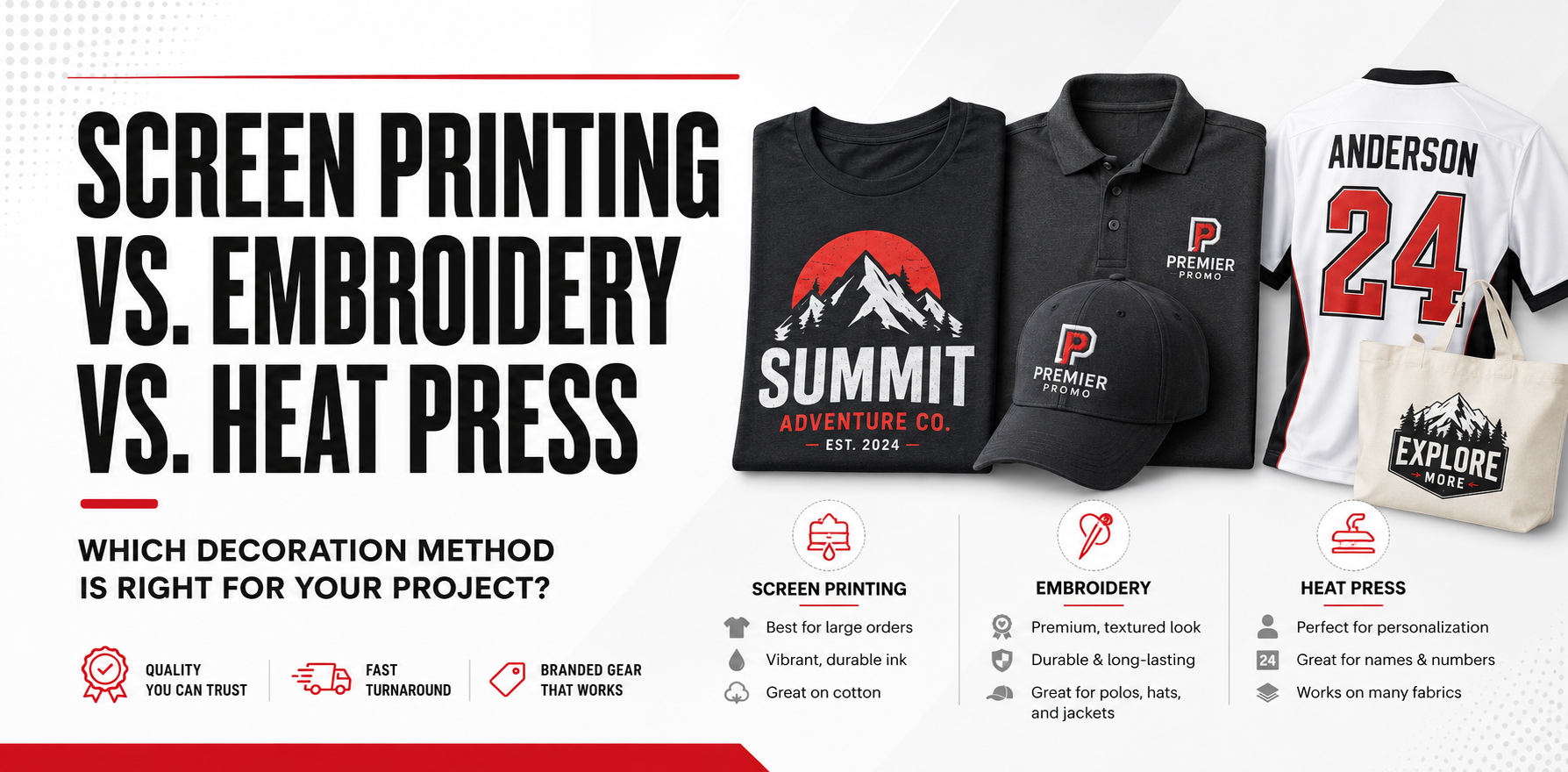
Screen printing, embroidery, and heat press are three of the most common decoration methods for branded apparel and accessories. Each offers a different appearance, feel, price point, and level of durability.
The best choice depends on several factors, including the garment material, order quantity, artwork, budget, and how the finished item will be used.
Understanding the differences can help you choose a method that keeps your project looking professional, on-brand, and appropriate for your audience.
What Is Screen Printing?
Screen printing uses ink that is pushed through a mesh screen and applied directly to the fabric. Each color in the design typically requires its own screen.
It is one of the most widely used methods for decorating custom T-shirts, sweatshirts, uniforms, and event apparel.
Screen printing works especially well for:
- Medium and large apparel orders
- T-shirts and sweatshirts
- Bold logos and graphics
- Designs with a limited number of colors
- School, team, event, and company apparel
Because much of the setup cost is completed before printing begins, screen printing often becomes more cost-effective as the order quantity increases.
Benefits of Screen Printing
Screen printing produces bold, vibrant colors that stand out well on both light and dark garments.
It is also durable when the correct inks and production methods are used. A professionally screen-printed design can withstand repeated wear and washing.
For larger orders, screen printing is often one of the most economical decoration options.
Things to Consider
Each ink color may require additional setup, so complicated designs with many colors can increase the cost.
Screen printing may also be less practical for very small orders because the initial setup is similar whether you are printing a few shirts or several hundred.
The texture of the print can vary depending on the ink, artwork, and number of colors used.
What Is Embroidery?
Embroidery uses thread to stitch a logo or design directly into the product.
It is commonly used for polos, jackets, hats, quarter-zips, workwear, uniforms, and corporate apparel.
Embroidery works especially well for:
- Company logos
- Polos and professional apparel
- Hats and visors
- Jackets and outerwear
- Work uniforms
- Premium employee or client gifts
Embroidery creates a dimensional, polished appearance that is often associated with professional and higher-end apparel.
Benefits of Embroidery
One of embroidery’s biggest advantages is durability. Because the design is stitched into the product, it does not crack or peel.
It can also elevate the appearance of a simple garment and make it feel more substantial or professional.
Embroidery is especially effective for smaller logo placements, such as a company logo on the left chest of a polo or jacket.
Things to Consider
Embroidery pricing is often influenced by the number of stitches required rather than simply the number of colors.
Very large or highly detailed designs may require more stitches, increasing both the cost and weight of the decoration.
Small text, gradients, and extremely fine details may need to be simplified so they can be reproduced clearly with thread.
Embroidery can also feel heavy or stiff when used for a large design on a lightweight garment.
What Is Heat Press?
Heat press decoration uses heat and pressure to apply a design to a garment or product.
Depending on the project, the design may be created using heat-transfer vinyl, printed transfers, direct-to-film transfers, or another specialty material.
Heat press works especially well for:
- Small apparel orders
- Individual names and numbers
- Detailed or full-color designs
- Short runs
- Team uniforms
- Personalized items
- Products that are difficult to screen print
Heat press decoration offers flexibility, especially when every item in an order requires different personalization.
Benefits of Heat Press
Heat press is a practical choice for small orders because it generally requires less setup than traditional screen printing.
It can reproduce detailed, colorful artwork and is ideal for adding individual names, player numbers, departments, or job titles.
It can also be used on a wide variety of products, depending on the material and type of transfer selected.
Things to Consider
Not every transfer works well with every fabric. The correct temperature, pressure, and application method must be used to avoid damaging the garment.
The finished design may have a different feel than screen printing or embroidery. Some transfers are thin and flexible, while others may feel heavier on the fabric.
Durability can also vary based on the type of transfer, garment, application process, and care instructions.
Screen Printing vs. Embroidery vs. Heat Press
The right decoration method depends on the needs of the specific project.
Choose Screen Printing When:
- You are ordering a medium or large quantity
- The design uses a few bold colors
- You need custom T-shirts or sweatshirts
- Cost per item is an important consideration
- You want a classic printed appearance
Screen printing is often ideal for large events, school apparel, team shirts, employee T-shirts, and promotional campaigns.
Choose Embroidery When:
- You want a polished, professional appearance
- You are decorating polos, hats, jackets, or uniforms
- The logo is relatively small and simple
- Durability is especially important
- You want the apparel to feel more premium
Embroidery is frequently used for corporate uniforms, sales teams, hospitality staff, management apparel, and client gifts.
Choose Heat Press When:
- You need a small quantity
- Every garment requires different personalization
- The design contains many colors or fine details
- You need names, numbers, or individual titles
- The project has a short turnaround or specialized requirement
Heat press is a strong option for sports teams, personalized apparel, short-run campaigns, and detailed full-color artwork.
Consider the Garment Material
The fabric and construction of the item can significantly influence the decoration method.
Cotton T-shirts are often well suited for screen printing, while polos, jackets, and structured hats are commonly embroidered.
Performance fabrics may require specialty inks, backing, transfers, or lower application temperatures.
Seams, zippers, pockets, coatings, and water-resistant finishes can also affect where and how a product can be decorated.
Selecting the apparel and decoration method together helps avoid production issues and creates a better finished result.
Consider Your Artwork
Not every design can be reproduced exactly the same way using every decoration method.
A highly detailed, full-color image may work well as a printed transfer but could require major simplification for embroidery.
A bold, one-color logo may be ideal for screen printing.
Small lettering may need to be enlarged or adjusted before it can be stitched clearly.
Before production begins, artwork should be reviewed to determine whether it is suitable for the chosen method.
Consider the Order Quantity
Quantity is another important factor.
Screen printing is often more cost-effective for larger orders because the setup cost is spread across more items.
Heat press can be more practical for small quantities because it may require less initial setup.
Embroidery can work for both small and large orders, although pricing may vary based on the stitch count, product, placement, and total quantity.
Consider the Final Use
Think about when, where, and how the item will be worn.
A company polo worn during client meetings may benefit from embroidery’s professional appearance.
A T-shirt distributed at a large community event may be better suited for screen printing.
A sports jersey that requires a different name and number for each player may call for heat press decoration.
The goal is not simply to choose the most familiar method. It is to select the method that best supports the product’s purpose.
Which Decoration Method Is Best?
There is no single decoration method that is best for every project.
Screen printing is often the right choice for larger apparel orders and bold graphics. Embroidery offers durability and a premium appearance. Heat press provides flexibility for small quantities, detailed artwork, and personalization.
In some cases, more than one method may be used within the same apparel program. A company may choose embroidered polos for its office team, screen-printed T-shirts for an event, and heat-pressed names or numbers for a sports program.
At Marked Promotions, we help customers evaluate their apparel, artwork, quantity, budget, timeline, and intended use before recommending a decoration method.
Our team can help you choose an option that looks right, performs well, and keeps your order on-brand and on-time.
Ready to start your next custom apparel project? Contact uso to discuss the best decoration method for your needs and request a quote today.