How to Build a Promotional Product Budget That Actually Works
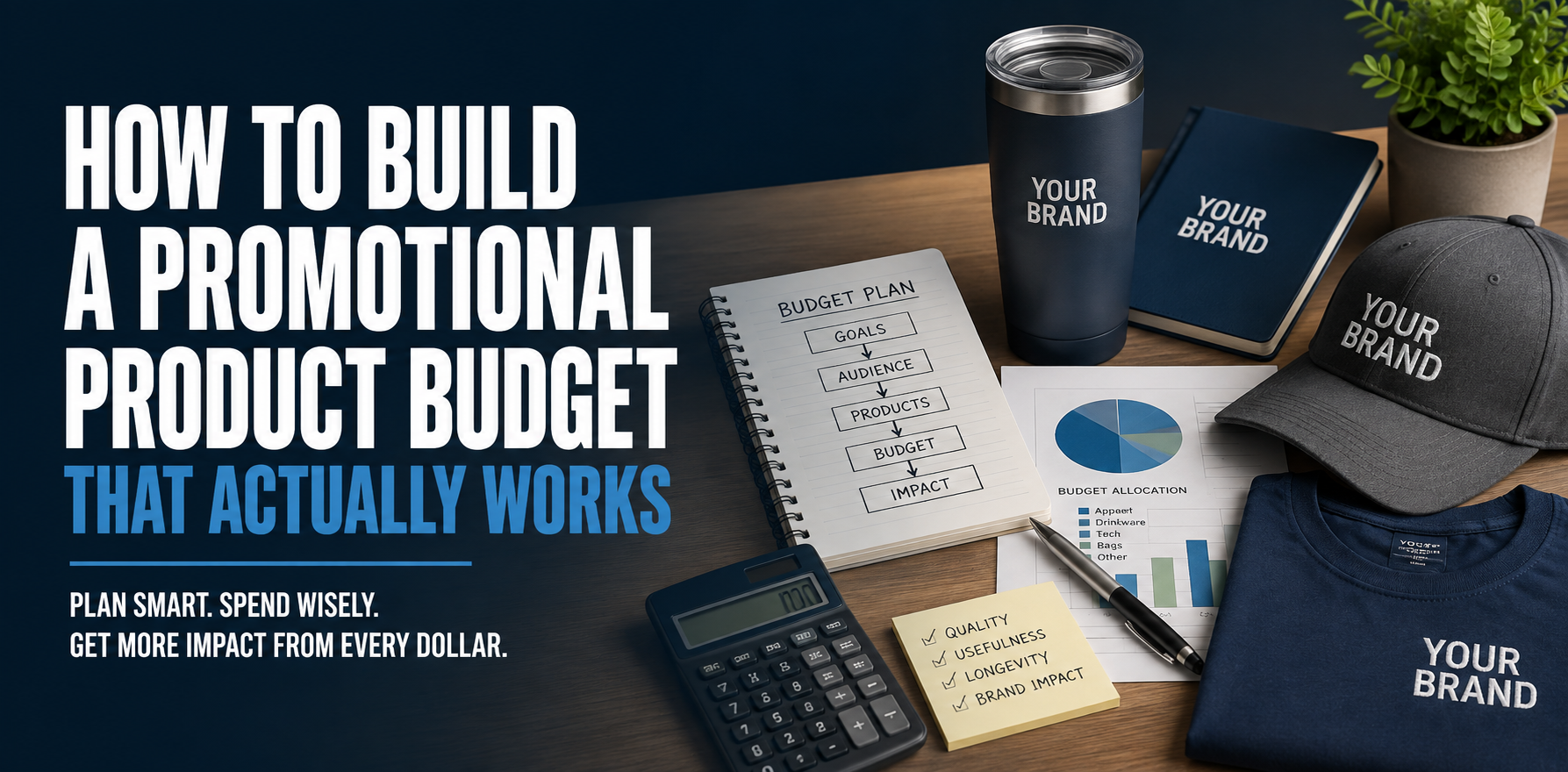
Promotional products can be one of the most effective ways to keep your brand visible, but figuring out how much to spend, and where to spend it, can be challenging.
Should you put more money toward apparel? Giveaways? Employee gifts? Trade show items? Premium products for clients?
The answer depends on what you're trying to accomplish.
Instead of starting with a product catalog and trying to work backward from the price, start with your goals. A well-planned promotional product budget should support your marketing strategy, not simply fill a box with branded merchandise.
Here's how to build a promotional product budget that makes sense for your organization.
Start With Your Goal
Before deciding how much to spend, determine what you want your promotional products to accomplish.
Different goals require different approaches.
You might be trying to:
- Increase brand awareness
- Attract people to a trade show booth
- Outfit employees with branded apparel
- Welcome new employees
- Thank customers or clients
- Support a fundraising campaign
- Promote a new product or service
- Create merchandise people will purchase
- Build a consistent company brand
Once you know the goal, it becomes much easier to determine what products make sense and how much you should allocate.
Think in Terms of Campaigns, Not Individual Products
One of the easiest ways to overspend, or underspend, is to look at promotional products one item at a time.
Instead, think about the entire campaign.
For example, if you're preparing for a trade show, your budget might include:
- Staff apparel
- Tablecloths or displays
- Giveaways
- Premium items for key prospects
- Printed materials
- Packaging or bags
Looking at the entire project allows you to make smarter decisions about where your money will have the greatest impact.
You may discover that spending slightly more on one useful giveaway is better than buying several inexpensive items that attendees will never use.
Consider Who Will Receive the Product
Not every recipient needs the same thing.
A product given to a potential customer at a large event may have a very different purpose than a gift given to a long-term client.
Consider creating different tiers within your budget.
General Giveaways
These are designed for broad distribution at events, conferences, community programs, and other large gatherings.
Because you may need hundreds or thousands of pieces, the cost per item is especially important.
Employee Merchandise
Employee apparel and branded products should balance quality, comfort, and practicality. If employees are expected to wear something regularly, investing a little more in the product can make a significant difference.
Client and VIP Gifts
For customers, prospects, or partners, fewer high-quality products may have more impact than a large quantity of inexpensive items.
The goal isn't simply to put your logo on something. It's to give someone a product they genuinely appreciate.
Don't Let Price Per Item Be the Only Consideration
A $3 promotional product isn't necessarily a better deal than a $6 product.
The real question is: Will people use it?
A product that gets used repeatedly can create ongoing brand exposure. Something that ends up in a drawer, or worse, the trash, doesn't provide the same value.
When comparing products, think about:
- Quality
- Functionality
- Frequency of use
- How long the item is likely to last
- How well it represents your brand
- Whether the product makes sense for your audience
A slightly higher upfront investment can sometimes produce significantly more value over time.
Plan for More Than Just the Product
Your promotional product budget may need to account for more than the item itself.
Depending on the project, consider:
- Artwork or design
- Decoration method
- Setup charges
- Packaging
- Individual fulfillment
- Kitting
- Storage
- Shipping
- Rush production or shipping
- Special product sourcing
This is particularly important for large events, company stores, employee programs, and projects with multiple delivery locations.
Understanding the complete cost upfront helps prevent surprises later.
Leave Room for Flexibility
It's tempting to allocate every dollar before you've even selected your products, but leaving some flexibility in your budget can be valuable.
Product availability changes. Your team may discover a better option. You might decide to upgrade an important item or add something to the program.
A little flexibility allows you to make those decisions without having to rebuild the entire project.
Work With a Promotional Products Partner
You don't have to navigate thousands of products on your own.
A good promotional products partner should be able to take your budget, audience, goals, and timeline and narrow the options down to products that actually make sense.
At Marked Promo, we work with organizations to understand what they're trying to accomplish before recommending products. That allows us to focus on the right combination of quality, price, functionality, and brand impact.
The Bottom Line
The best promotional product budget isn't necessarily the biggest one.
It's the one that puts your money toward products your audience will actually use, products that represent your brand well, and products that support a specific marketing or business goal.
Start with the objective. Identify your audience. Determine where the products will be used. Then build the product mix around those factors.
And if you're not sure where to start, that's exactly where a promotional products partner can help.
Ready to build a promotional product program around your budget? Marked Promo can help you find the right products, decoration, and strategy for your goals. Request a quote here.